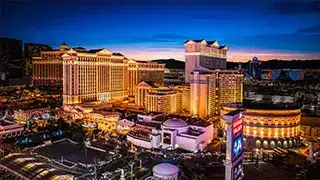
Why the Iconic Caesars Palace Still Defines the Las Vegas Experience
Byline: Lydia Gordon
Key Takeaways
- Caesars Palace remains the most influential resort on the Las Vegas Strip
- The resort has been almost entirely reinvented while retaining its identity, with major renovations now redefining its luxury
- The Colosseum at Caesars Palace transformed live entertainment in Las Vegas
Since its debut in 1966, Caesars Palace has managed to stay timeless while never standing still.
Las Vegas Mythmaking in Marble
Many of Caesars Palace's earliest architectural features remain a cornerstone of the resort today. Before you even enter the hotel, you’re greeted by a marble replica of the Winged Victory of Samothrace, a statue designed to evoke the same sense of grandeur that founder Jay Sarno wanted guests to feel as they entered his imagined Rome. Towering Corinthian columns still support the casino’s promenades, and mosaic tile patterns that line select corridors echo Sarno’s love of classical art.
But built on that foundation are centuries' worth of evolution compressed into just a few decades. Sarno built his domes, barrel-vaulted ceilings, Corinthian columns and grand fountains to make guests feel like arriving dignitaries: every guest was a “Caesar,” a philosophy as relevant today as it was in 1966. With that idea at its core, Caesars Palace became a classical backdrop for all the modernizing and imagineering the following decades could bring.
Over the last decade and a half, the resort has methodically upgraded almost every layer of the experience while preserving its Roman bones. The former Forum Tower has been reborn as the Colosseum Tower, with more than 400 redesigned rooms and suites that pair classical motifs with clean modern lines. Across the 85-acre campus, towers like Octavius, Augustus and the renovated Colosseum Tower now deliver thousands of rooms that weave in contemporary furnishings with ancient references remaining firmly in place.
Next-Gen Energy Meets the Early Empire
Caesars Palace is treating the coming decade as its next chapter, using its foundation as a playground for current and futuristic enhancements. Those upgrades are tightly linked to Caesars Entertainment’s extended role as a founding partner of the Formula 1 Heineken Las Vegas Grand Prix through 2030.
The extended Formula 1 agreement is elevated by the ongoing reinvestment in Caesars Entertainment’s Las Vegas portfolio, with Caesars Palace receiving some of the most visible upgrades. A beautifully-executed rebuild of the original main entrance delivered a soaring new dome ceiling. The reimagined Colosseum Tower, new high-limit rooms and Flavian Sky Suites are a sight to behold. Now open at Caesars Palace are the Colosseum Presidential Villas, two connecting villas spanning more than 19,000 square feet with sweeping rooftop views. And atop the 68th and 69th floors of the Octavius Tower, 29 Octavius Sky Villas offer one- to three-bedroom configurations with panoramic Strip views.
The resort is using its Formula 1 runway to rethink some social spaces as well. A forthcoming OMNIA Dayclub & Skybar is part of a larger plan to create a continuous day-to-night energy corridor. It will open as a 46,000-square-foot complex with two pools and performances from top global DJs, creating a new social anchor that plays off the already-iconic Garden of the Gods Pool Oasis. Behind the scenes, nearly 1,000 suites in the Augustus Tower will be fully renovated by Peter Silling & Associates, with a new VIP check-in lounge making arrival its own luxury ritual. By 2027, the Julius Tower and Palace Tower will follow suit, with more than 1,700 rooms slated for full renovations. These upgrades will recast the resort as a refreshed empire, where legacy architecture frames entirely new rooms.
Where Icons Live: Design, Entertainment, Wellness, Dining
If architecture is Caesars' body, The Colosseum is its beating heart. When the venue opened in 2003 to house Celine Dion’s A New Day residency, it redefined what live performance in Las Vegas represented. In The Strip’s “Before Colosseum” times, residencies in the city had been a retirement pasture for stars. Dion’s residency at The Colosseum turned legacy into currency. Over the years, artists like Elton John, Mariah Carey, Rod Stewart and Adele have turned its stage into their own amphitheater. Its renovations, with a multimillion-dollar acoustic enhancement, upgraded lighting and custom retractable seating, ensure it remains one of the most iconic performance spaces in the world. Yet its aesthetic remains loyal to the original concept: a grand Roman coliseum reborn as a temple of pop culture, where no guest sits farther away than 145 feet from the action.
Outside, the Garden of the Gods Pool Oasis stands as perhaps Caesars' most photographed sanctuary. Seven distinct pools, each named for a Roman deity, spread across five acres of travertine terraces. The Neptune Pool’s party atmosphere (imagine ancient Rome with a great DJ and Dole Whips) contrasts with the quieter Venus Pool, satisfying both spectacle and serenity seekers. If you're looking for a game but want to stay cool in the water, head to the Fortuna Pool, for swim-up blackjack.
Caesars Palace began an entirely new design story when it partnered with Nobu Hospitality to launch the world’s first Nobu Hotel in 2013, a boutique hotel within the resort that integrates an exclusive tower with the first Nobu Restaurant & Lounge on The Strip. Following a multimillion-dollar refresh, the 182-room hotel now features a modern, residential feel inspired by kintsugi, with natural materials, warm wood tones and Japanese motifs.
QUA Baths & Spa, already refreshed as part of the resort’s recent upgrades, now features The Strip’s first AI-powered robotic massage, by Aescape, and new wellness programming with yoga, sound healing, personal training and specialized treatments.
Long before “celebrity chef” became standard Strip vocabulary, Caesars leaned into the notion that dining could be a spectacle on par with gaming and shows. Today, that spirit continues with restaurants by Gordon Ramsay, Nobu Matsuhisa and Bobby Flay. Guy Savoy anchors Caesars fine dining, serving one of the country’s most sophisticated tasting menus and operating one of the only Krug Chef’s Tables in the U.S., with 10-course, Champagne-driven experiences that turn French haute cuisine into evening-long theater.
A Timeless Vegas Mainstay
Consider what the city sells: escape. Every flashing sign and transporting interior is the promise of another story, or even just a night off.
Culturally, Caesars has long served as a shorthand for the city in film, TV and live events. When big moments play out here, from fight nights to residencies to Formula 1 hospitality, they don’t just sell rooms. They help define what counts as iconic in Las Vegas at large. In a city famous for its implosions, Caesars Palace has kept its Roman foundation, letting its upgrades play into the future, like AI-powered massages, rooftop villas, chef’s tables, presidential-scale sky villas and race-week viewing lounges.
The lasting value of Caesars is its adaptability. That tension between ancient Rome and the future Strip is exactly why Caesars Palace continues to feel like the definitive Strip resort, at once the keeper of Las Vegas tradition and an incubator for its next innovation.
FAQs
What makes Caesars Palace one of the most iconic hotels in Las Vegas?
Caesars helped pioneer the fully themed megaresort, wrapping guests in Greco-Roman architecture, fountains and even Roman baths to make every guest feel like a “Caesar.” It is famous for its central location, massive scale, The Colosseum theater that defined the Las Vegas residency as we know it today and its celebrity chef-helmed restaurants.
How has Caesars Palace changed in the last decade?
In the last decade, Caesars Palace has heavily invested in renovating its towers and rooms, including updating its Palace Tower, turning the Roman Tower into Julius Tower and remaking Forum Tower as the modern Colosseum Tower. It has revamped the main entrance and casino areas, refreshed The Colosseum and added marquee-name dining like Peter Luger Steak House, Dominique Ansel and Stanton Social Italian.
What is Caesars plan for the next ten years?
Caesars is completing more upgrades through 2027, including adding a three-story OMNIA-branded dayclub, reshaping the resort’s frontage on Las Vegas Boulevard. It has extended its founding partnership with the Formula 1 Heineken Las Vegas Grand Prix through 2030, positioning it as a recurring hub for Formula 1 activities, and planning entertainment, viewing decks and packages around Formula 1.